Complete Sermon Details
Message Overview
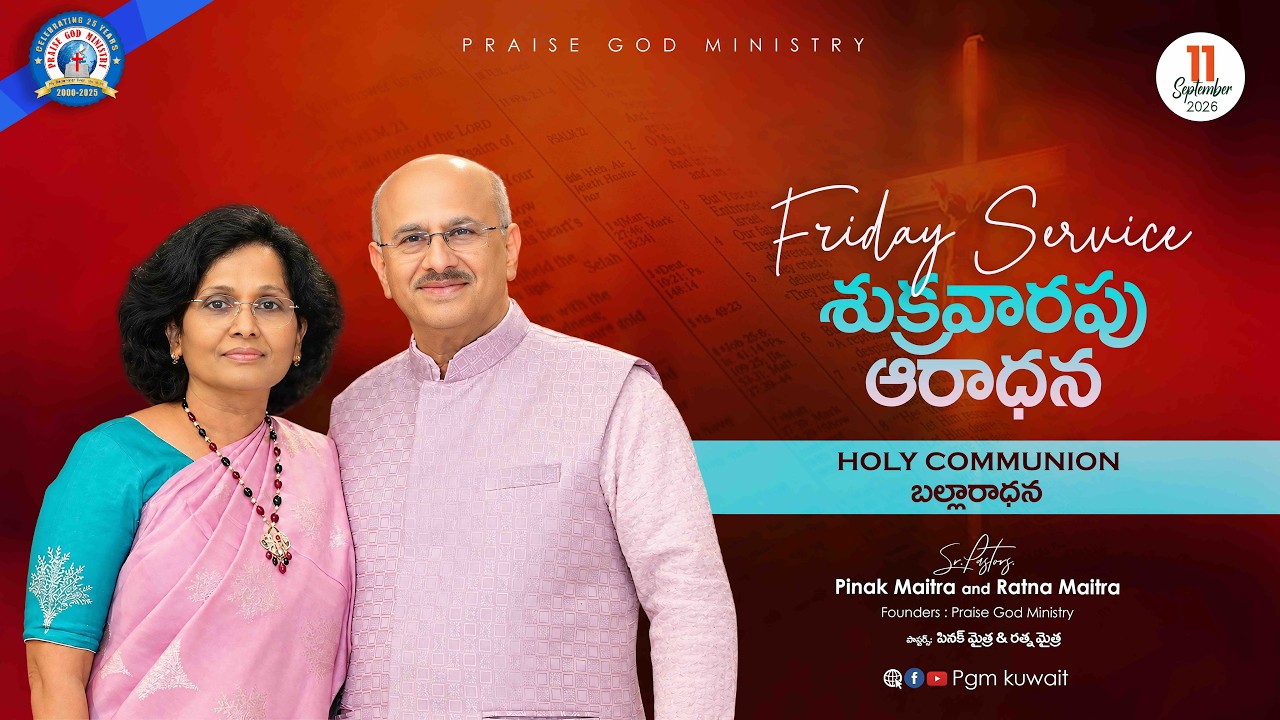
In this Friday service at Praise God Ministry, the congregation is led through worship, personal testimonies, and an impactful exposition of the Scriptures by Ps. Ratna Maitra.
### Testimonies and Worship
The service opens with members of the congregation giving testimony to God's healing power, deliverance from illness, and faithfulness amidst trial. The worship team leads the assembly in devotional songs that emphasize the Father's guidance and mercy, setting an atmosphere of reverence and expectation for the preaching of the Word.
### The Parable of the Prodigal Son (Luke 15)
Ps. Ratna Maitra bases her message on Luke 15, specifically exploring the context surrounding Jesus' teaching. In the beginning of the chapter, Pharisees and scribes complained that Jesus received sinners and ate with them. In response, Jesus told three distinct parables illustrating the theme of 'lost and found'—the Lost Sheep, the Lost Coin, and the Lost Son.
Focusing on the Prodigal Son (Luke 15:11-32), Pastor Ratna explains the profound cultural gravity of the younger son's demand for his inheritance while his father was still alive. In ancient Middle Eastern culture, requesting inheritance early was equivalent to wishing the father dead and brought immense shame upon the family and community.
### The Father's Reaction vs. Cultural Expectations
When the son squandered his wealth in a far country and sank to the lowest status—feeding swine—he eventually came to his senses and decided to return home as a hired servant. Under traditional communal practices ('Kezazah'), a son who disgraced his family and lost his inheritance to Gentiles would face public humiliation, cursing, and complete rejection by the community upon his return.
However, the father ran to meet his son while he was still a long way off. To run in that cultural context, an elder nobleman had to hitch up his robes, exposing his legs, which was considered deeply humiliating. The father willingly took on the shame and humiliation himself to reach his son before the angry community could reach him with curses and rejection.
### Restoration of Sonship
Instead of allowing his son to become a servant, the father embraced him, kissed him, and immediately ordered the best robe, a ring, and sandals for his feet:
- **The Robe:** Restores honor and covers his rags of shame.
- **The Ring:** Restores authority and family identity.
- **The Sandals:** Signifies that he is a free son, not a barefoot slave or servant.
Ps. Ratna emphasizes that Jesus did the same for humanity on the cross. He bore our shame, endured public humiliation, and broke the curses against us so that we could be fully reconciled and restored into the family of God.
Scripture References
Luke 15:1-32; Luke 19:10; 2 Corinthians 5:17-21; Galatians 3:13; Galatians 3:26-28; Ezekiel 37:1-14
Key Points
- Religious legalism separates and condemns sinners, but Jesus actively seeks and receives them.
- Requesting an inheritance early was a grave cultural offense that brought public shame upon the family.
- The father running to meet the son demonstrated self-sacrificing love to protect his child from community condemnation.
- The best robe, ring, and sandals symbolize the complete restoration of honor, authority, and freedom as a child of God.
- Jesus endured the shame and curse of the cross so that we might be saved and welcomed into eternal life.
Practical Applications
- Never hesitate to return to God when you fall or make mistakes; His grace and mercy are always waiting.
- Avoid judging or condemning others who have backslid or sinned, following Jesus' example of compassion.
- Live confidently in your identity as a restored son or daughter of God, free from guilt and shame.
Prayer Points
- Pray for those who feel distant or estranged from God, that they may experience the Father's welcoming love.
- Pray for spiritual restoration and healing across families and communities.
- Pray for believers to be bold ambassadors of reconciliation, bringing the Good News to those in need.